By now, you should know the order of diatonic chords in major and minor pretty well. Here’s a quick recap:
Major: I ii iii IV V vi viidim
Minor: i iidim III iv v (or V) VI VII (same order as major, just starting on vi).
All there, at your convenience. Easy enough, right?
Well, not exactly.
See, it’s all well and good to play and write music completely diatonically, but oftentimes, this method can come out sounding a little, well, bland.
Enter the mighty chord substitution!
In any key, there are always a litany of chords that you can use to spice up- or entirely transform- your progressions and compositions.
First off, what exactly are chord substitutions? There are 2 main types, these being:
1. Diatonic chord substitutions, i.e a chord that plays the same functional role as another chord in that key,
and
2. Non- diatonic chord substitutions i.e any chord substitution that is non-diatonic to the key (meaning it can’t be naturally built out of the notes of that scale).
Chord substitutions are most commonly used in functional harmony, though a number of substitutions are useful for ‘modal mixture’ & ‘modal interchange’- especially with non diatonic chord subs (more on that in a second).
Today, we’re going to just be looking at non-diatonic chord substitutions, as they can provide some of the more ‘vivid’ colours and visuals to your tunes.
Food For Thought
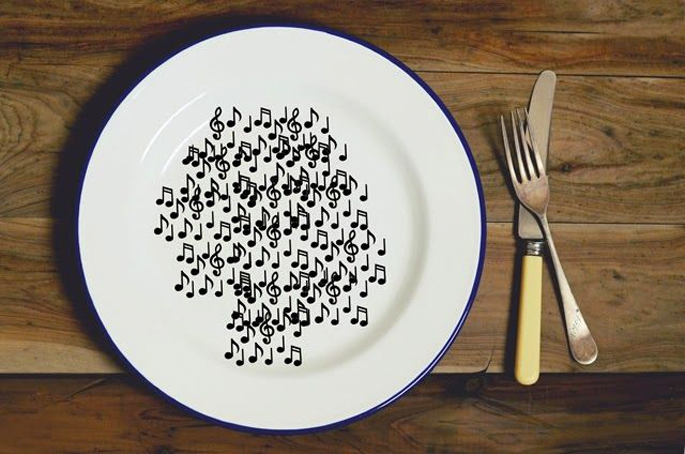
I like to think of chord substitutions as analogous to cooking a meal: A a few subtle chord substitutions for some spice and seasoning, or use a whole lot for a full on chilli con carne.
Though, beware. Use too many and you’ll spoil the broth with a bit of the ol’ atonality. Let’s get cooking.
Keep in mind this is by no means a comprehensive list, as there are essentially and unlimited bank of chord substitutions that you can pull from. These are simply a list of the most common and useful substitutions.
iv in Major
Using a minor iv in a major is one of the best and easiest ways to introduce emotion, anguish or solemness into a regular plagal (IV-I) cadence, by creating what’s commonly known as a ‘minor plagal cadence’. Especially useful after a major IV chord, the iv can musically accompany themes from unrequited love, to death and mourning. Radiohead’s No Surprises is a prime example of this, alternating between I and iv.
IV in minor
In minor, we also have the inverse. The use of a IV chord in a minor tonality is commonplace in classic rock and blues (among a litany of other styles), and evokes a Dorian tonality through its inclusion of the natural 6th. This is an easy way to brighten up your minor chord progressions, and bring a feeling of hope to the musical table. This can be especially useful as a transition to a V, adding a dash of Melodic Minor flavour. A great example of the i- IV comes in the verses of Electric Light Orchestra’s Mr. Blue Sky.
III in major
This soulful chord is a staple of Gospel and RnB, and one of the most straightforward ways to transition into your vi, or relative minor (in this case, the chord would be described as the V of vi). The chord can also be used to transition up a half step to your IV, giving a Lydian tendency to the resolution that can help establish a dreamy and uplifting feel to your progression; an example can be seen in Pink Floyd’s Nobody Home at 0:35.
bV/#IV in minor
Known as the ‘tritone chord’ this chord away from the root is like the musical equivalent of adding a ghost pepper into the musical mix. One of the most evil-sounding transitions can come through the use of this chord. As part of a #IV to V, this chord can create a dastardly- sounding chord cycle in minor keys, especially useful for neoclassical pieces. You can find this chord in a number of tunes by Yngwie Malmsteen, and his neoclassical contemporaries (Paul Gilbert, Michael Angelo Batio, etc.)
bVI/bVII in major
These chords-often used in conjunction with each other- are borrowed from the parallel Aeolian (natural minor) scale (e.g Ab major and Bb major in the key of C major are both borrowed from C Aeolian). Using these in a bVI-bVII-I progression can create a massively impactful resolution back to the I, often described as a ‘backdoor resolution’. Some examples of this cadence can be seen in Dream Theater’s To Live Forever (see if you can spot it), as well as the flagpole victory theme in Super Mario. These chords contribute to a grand, victorious-sounding resolution that can add huge punch to the end of a piece.
bVI7 in minor
This chord is one of the best ways to make your V-i in minor flow more smoothly and effectively, through its use of the ‘tritone substitution’ – alternatively known in classical music circles as the ‘augmented 6th’ chord. Especially useful after the bVII in minor, in transitioning to V-i, this whole progression (i-bVII-bVI7-V-i), is what’s known as the ‘Andalusian cadence’ a staple of ethnic Spanish and Flamenco music. This is one of the better ways to add an exotic Spanish flavour to your songs, essentially adding jalapeños to your musical dish. One of the most profound examples can be seen in Al DiMeola’s Mediterranean Sundance, where it sets up a classic and iconic resolution back to the i.
bII in major or minor
You’ll often see this described as a ‘neapolitan chord’ in circumstances which it precedes the V. Borrowed from the parallel phrygian mode, the bII can be used in a similar manner to the #VI/bV: a massively destabilising and evil-sounding chord, especially useful in metal, or preceding the V, as the bII is a tritone away from the V. This chord can alternatively be used as a ‘lift’ in progressions, to bring newfound vigour and life to your songs, and is a veritable swiss army knife when it comes to modulations. Metallica’s One is a key example of this substitution, though its more beautiful side can be seen in the intro to Floyd’s The Great Gig in The Sky.
Spoiled for choice
So, which of these ingredients do we choose to add to our dishes? Choosing them all can very well result in an over-indulgent and sickly dish.
The key here is context. What you want here is to consider the overall vision for the piece: what you want it to convey, and what story you want your song to tell. These in mind, your chords should help support this vision, and convey the emotions and visuals that come with it.
Always keep the vision you have for your music in mind.
Something to watch out for
You should also keep your melody in mind. Whatever chords you sub in, you want to make sure they don’t clash (i.e have notes a minor 2nd or tritone) away from the melody line. Though, this does ultimately depend on the overall vision you have for the piece, and if you are wanting to include dissonances and clashes in your songs, by all means, go for it.
And now there’s only one thing left to do.
Get writing!
Want the Free Ultimate Prog Chord Compendium? Just sign up below!
Processing…
Success! You're on the list.
Whoops! There was an error and we couldn't process your subscription. Please reload the page and try again.
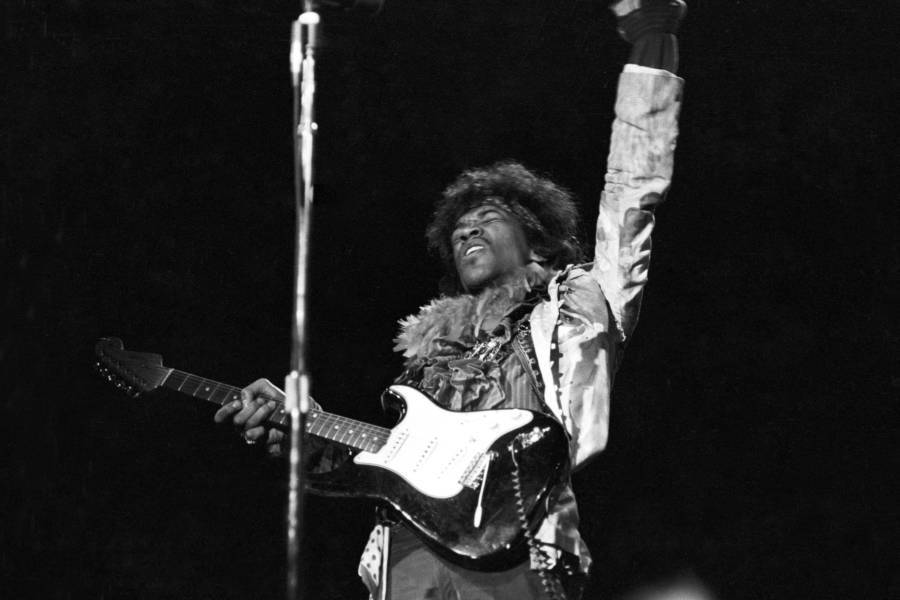
Over the past few weeks, I’ve been undertaking a study of Jimi Hendrix’s classic take on All Along The Watchtower with one of my students.
Initially, the study was only due to take a couple of weeks, but it provided so many interesting points of discussion between myself and my student that it mutated into a month-long, behemoth of a look at the song that we spread out over a period of 5 or so sessions.
Over this period of time, we used the concepts seen in Hendrix’s solos as a springboard into a number of other topics. Most namely, though, came Hendrix’s masterful way of storytelling through his solos and musical devices, all the way until the fiery, iconic climax that rounds out the piece.
Naturally, this got me thinking about how similar songwriting is to storytelling, and why a force so simple (yet so profound) as music can conjure up images of sweeping fields, or bustling cities, with only the power of sounds and lyrics. Hence today’s post.
So how can weuse these concepts?
Each great narrative has a set of common elements that they share. Some deviate slightly, but these are largely similar between the vast majority of great stories throughout history.
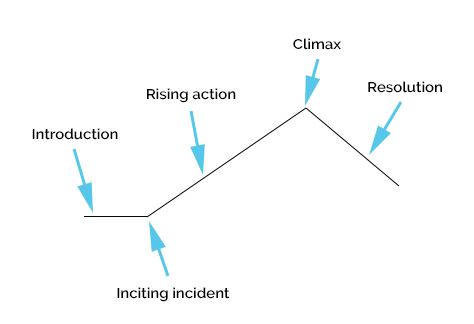
The structure shared by the majority of narratives
Though it may seem unlikely at first glance, this narrative scaffolding can just as easily apply to your songwriting process. Thinking of songwriting as analogous to storyboarding/ drafting a film, book, or videogame can prove one of the biggest and best boons for your songwriting.
It provides direction and context to your discretion in choosing musical features, and – if done well – can allow you to craft pieces that extend beyond just music- into the realm of high art.
Let’s storyboard.
Orientation/introduction:
This is where the scene of the song is set, the key players are introduced, and the overarching tone of the story is provided. The introduction of a story serves an important chance to foreshadow the themes/events that’ll occur later on, including the climax and finale of your piece
Often, it can be of significant merit to open with an engaging ‘hook’- this could range from the presentation of a main riff/melody immediately, or an especially infectious fill/passage. Either way, a hook should – much like any great story – serve to capture and absorb the listener in the music instantaneously.
I like to think of the ‘setting’ introduced by the story as similar to an introduction of key/tonality in your song, with recurring motifs and ideas being the main ‘characters’ of the story.
Setting up key motifs and riffs that you plan to use throughout the remainder of your song can be seen as a means of musical foreshadowing. One of my favourite examples of this method is Dream Theater’s Octavarium. Give the introduction from 0:00 to 3:47 a listen, and challenge yourself to recognise the key motifs and features that appear later in the piece- all set up by this incredible introduction.
Inciting event
Also known as the ‘conflict’, the inciting event is the point in time (usually fairly early on in the story) in which a problem – one with no clear solution at this point – is presented. This problem must be gradually worked through as the story progresses.
This can be seen musically in what I like to call the ‘kick-in’- the moment when the rest of the band comes in, hitting the first chord, or when the first solo begins. Continuing with our examples of Watchtower and Octavarium, the inciting event(s) can be heard at 0:10 and 3:49, respectively, as Dream Theater ploughs through a massive chord, and Hendrix launches into his fiery solo.
The inciting event can also be expressed in your lyrics’. In Watchtower, Dylan’s original projects this conflict immediately:
There must be some kind of way out of here
Said the joker to the thief
And in Octavarium:
I never wanted to become someone like him so secure
Content to live each day just like the last
Immediately beginning your first verse with an explosive or engaging line is one of the best ways to communicate the key issues your song is going to tackle.
Rising Action
Also known as the ‘series of events’, the rising action of a narrative is generally the longest and largest section – both duration and volume of content-wise. It can include its own subplots, and generally has its own peaks and valleys in terms of intensity of events, though these peaks are generally less profound than the larger climax, and the valleys less deep than the interlude.
Musically, a songwriter’s ability to add variation and nuance to already-established riffs/ motifs is one of the critical traits in creating effective rising action. Layering different parts/rhythms/instruments can also add to the effectiveness of your rising action, though keep in mind that if you overdo your rising action sequence by inclusion of too many sections, you can easily back yourself into corner – making this section ineffective and difficult-to-follow.
One of the biggest risks here is avoiding monotony; keep in mind that you want your rising action to have its own sub-peaks and valleys: aim to have your complexity and tension look like the line graph projections of a company steadily growing. Throughout this section, it’s good to maintain a steady incline of tension, lest you risk your song sounding deflated and underwhelming.
For best results, aim to have your rising action look somewhat similar to the above line.
Lyrically, here’s your chance for more of your plot exposition. One of the most useful techniques to making your series of events lyrically engaging is by using the 7 senses (sight, sound, touch taste, smell, bodily, kinaesthetic) as the basis for your lines and stanzas. By using sensory detail, you can create vivid imagery that will supercharge your ability to propel the song forward. (For more on sensory writing, check out Pat Pattison’s Writing Better Lyrics, a great guide that has a number of in-depth lessons on the topic).
In Watchtower, Hendrix uses the verses as a means of injecting continually intensifying complexity into his embellishment of chords, thus maintaining a general incline in terms of tension- building. Notice how well Dylan’s imagery and dialogue-based stanzas play into Hendrix’ music, making for an exciting series of events that proves engaging lyrically and musically.
Depending on how prog you want to get, these variations can expand into whole new sections, as Dream Theater does in their instrumental sections/ ‘sub-songs’. Notice that each of these internal pieces has their own highs and lows, yet all function to push the story forward, and keep its momentum at a consistently interesting level.
Interlude
One of the keys to effective storytelling is contrast and juxtaposition, and the exact same principle applies to the creation of music. Songs that ‘go hard’ for the entirety of their duration can easily become tired – even irritating – and even most ambient music pieces have their own variations to keep the piece from verging too close on monotony.
Contrast- It’s what creates ‘yin and yang’ in our music.
The interlude – most often seen before the climax of the narrative structure – could be likened to the ‘calm before the storm’ – a section of tranquility or variation before the song kicks into high gear.
This is most often expressed through the Middle Eight, Bridge, Solo, etc., in popular music – though both progressive and jazz music can see a marginal to drastic change in tempo, harmonic progression/ tonal centre, time signature – and in some cases – even a complete change of style/genre.
One of the biggest challenges with making your interlude effective is ensuring that it doesn’t feel forced or shoehorned in its inclusion. Stylistically, it should build upon – not detract – from the previous musical elements presented. However drastic of a change it happens to be, make sure that in some way, it bonds cohesively to other elements/motifs; make it feel at home.
Lyrically, the interlude is a great opportunity to give listeners a new take on the subjects previously presented, or to reveal the the ‘revelation’ that drives the music into its grand finale.
Examples can be seen in Octavarium- from 20:00 to 21:00, where the (relatively!) calm sectional deviation precedes what’s often called the ‘God Solo’ by Dream Theater fans (give it a listen and I’m sure you’ll agree). Watchtower’s interlude comes in the form of the slide, wah, and chordal solos from 2:00 to 2:49, after which the piece kicks into its incendiary final verse and solo.
Climax
Here’s where things get big.
The climax should represent the culmination of your story thus far- where all the elements constitute a musical whole that ideally outweighs the sum of its parts.
If you’ve been making use of motivic devices rhythmically, melodically, or harmonically throughout your piece, tying back to them here is a great way to drive home the impact of this section. An effective climax is, in a word:
Massive.
In classical music, a piece’s climax is often expressed through its cadenza, in which the primary instrumentalist will show off their virtuosic chops through an especially monumental solo-based section. This cadenza-type finale can be seen in Octavarium‘s climax, from 21:29 until its tension culminates in the bend at 23:00.
The ‘God Solo’ in full force
In Watchtower, this comes in the form of what’s regarded by many as the single greatest bend in rock music; at 3:39, Hendrix’s high C soars above the musical landscape for one of the most epic 20 seconds in musical history.
Resolution / Finale
Once all is said and done, the big finale of the piece has passed, and the dust has settled, it’s time to bring things to a close.
Musically, a piece will often end three ways:
The ‘happy/expected’ ending: A song resolves to its home tonality, completing the cycle of tension introduced in the piece’s climax.
The ‘deceptive/twist’ ending: This kind of resolution subverts the listener’s expectations; it may come through the inclusion of a deceptive cadence, or a final, unforeseen section preceding the close of the song.
The ‘non-ending/unresolved’ ending: This can be easily achieved by hanging on the chord purposed to resolve to the tonic/root chord, creating a sense of tension and unease.
Tying back to the orientation of your musical story during the resolution helps bring the piece full-circle, especially terms of cohesion. Effective resolutions allow your music to transform from a simple collection of musical ideas into a unified, actualised whole.
The vast mass and gravity of Octavarium‘s collection of musical ideas sees it fit that it makes use of our first type of ending; the massive chordal hit that brings close to the piece also sees a recapitulation of its main motivic melody, much in the same vein of the cinematic film epics that it functions in equivalence to.
Watchtower‘s grand finale simply fades away; though its ending is much less pronounced and distinctive than Octavarium‘s, it proves just as thematically appropriate. As expressed in the lyrics, the ‘howling wind’ seems to carry this finale away with it – and despite having resolved on the root – maintains an element of suspense and uncertainty lyrically:
Outside in the cold distance A wildcat did growl Two riders were approaching And the wind began to howl
These final lines of Dylan’s lyrics leave us on an ambiguous resolution that suggest there’s still more to come.
This week’s challenge: write a song in the context of an already-existing story
Using the events of a pre-existing book, film, or game as a prompt for the context of your own music is one of the most fun and exciting ways to come up with some of the best music you’ll create.
For one, it allows you to construct an overarching vision and purpose for the song, one of the most important elements when it comes to ensuring cohesion and direction.
Secondly, it gives you a basis for your musical choices when songwriting, and ensures that each musical device you employ is both purposeful and intentional.
It also gives you a clear structure for your story to follow; any great story has all of the aforementioned narrative elements; being able to express these clearly and purposefully will both challenge and expand your overall musicianship and songwriting capacity.
Indirection is one of the greatest enemies of great songwriting, but using the aforementioned principles wisely and tactfully will help to flush it out of your songwriting process. Give it a try and comment below how you found it.
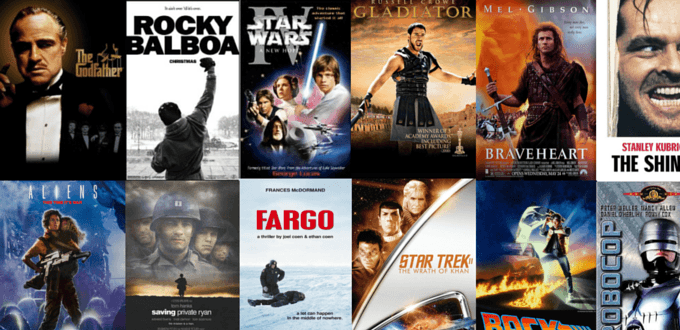
Choosing one of these classic films as a springboard for your songwriting could be the first step to revelation.
A Final Word
Today we’ve looked at utilising narrative structure in context of single songs/pieces, though keep in mind that they can also apply on a micro scale – for use in shorter songs of ~4 minutes, to medium-scale: multi-movement pieces like Octavarium, to macro-scale, such as throughout whole concept albums.
Remember that all these concepts are simply suggestions to assist you in the process of songwriting, not rules set in stone. By all means, break these rules in any way you see fit, and interesting results are sure to follow.
And above all, remember that songwriting – just like any other craft, is the product of time and pressure, and using this philosophy takes time and effort. Don’t kick yourself if writing in this manner initially feels difficult or forced, and remember that you are always your worst critic; keep your head up and your eyes on each little victory.
Now go and write the best music you’ve ever written.
Want the Free Ultimate Prog Chord Compendium? Sign up below!
Processing…
Success! You're on the list.
Whoops! There was an error and we couldn't process your subscription. Please reload the page and try again.
I believe that transcribing music is the secret superpower we never knew that we had.
It’s widely underrated and under-utilised, despite its incredible ability to boost the musicianship of everyone that uses it, tenfold.
Don’t believe me? Read ahead, and soon you’ll see the myriad of benefits that transcribing music can offer (that is, if you take the necessary steps to do it right!).
What Is Transcription?
First, (for those of you who don’t know), what is transcription?
-Transcription is simply the conversion of an aural format into a visual one (that is, music to text and symbols).
-We use music notation to convert what we hear into visual representations of the notes, or chords, on the musical staff, and denote their duration, or time, by using different shapes for different time values.
-We generally also use a key signature to help the musician reading the sheet more easily identify the key the piece is in, and adapt themselves accordingly.
The Benefits of Transcribing
I simply can’t list all of the numerous benefits that transcription of music has for your improvising, listening, and writing skills, but here are a select few:
1. In its essence, the conversion of an audible medium to a tangible, physical form provides a ‘map’ of sorts for the compositional/ improvisational style of the artist you are transcribing; this allows you to visualise their sound and notice patterns and habits in their playing that you can then adapt into your own style.
2. Forget tedious interval naming and ear training, transcribing music allows you to internalise intervals, scale degrees, chord qualities and a number of other musical features, and in doing so out, permanently train your ear to instinctually recognise the sounds of intervals and chords.
3. Huge practicality: If you’re ever in a situation that involves learning songs with little to no notice, I guarantee you that having the prior knowledge of transcription will almost certainly give you the upper hand when it comes to learning and internalising music.
4. Transcribing is a great way to dive headlong into learning a new genre, instrument, or style: having a concrete reference of the music allows you to SEE the devices that are hallmarks of the style, and how they apply to a wider musical context
5. And finally, transcription almost automatically improves your personal writing and improvisation. Hearing music and manually figuring it out (whether you know it or not) imprints said music into your subconscious mind; the music you have covered will manifest itself in your individual sound.
Transcription Tips and Hacks
Here are a few hacks to help supercharge your transcribing powers:
1. The first thing you’ll want to identify is the overall tonality of the piece (E.G B major, D minor, F# mixolydian, etc.) this way- whereas you previously had 12 possible note choices for the note you’re looking at- you can now narrow that choice down to 6 or 7 notes. This should generally be written out as a key signature on your score.
2. Building on the last tip, it’s often also helpful to narrow down whether the next note goes up or down, by step or by leap. Yes, pretty simple, but this will often help narrow that pool of 6 notes down even further into just 4 or 5.
3. If you’re trying to figure out the chords of a piece, always listen to the bass for the roots of the chord. Try identifying the note name of the chord first (e.g ‘this is A something), and then comparing it to your key, which will most likely tell you the chord quality. Most extensions/ alterations to chords can generally be found in the upper register, so picking those higher notes out is easier than you think.
4. If possible, transcribe with a pen and paper. Science has linked the physical act of writing with a much greater retention of information, as well as enhanced digestion of material. So, for maximum impact, always have a pencil and paper ready!
What To Look For When Transcribing
Here are some key points you’ll want to look out for whilst transcribing:
-The key the song is in (key changes, modal interchange, etc.)
-Scale types the soloist is using, and how they apply to chords
-Find arpeggios the soloist is using (are they outlining the chords? Are they creating extended/polychords?)
-Articulations/technique (What articulations are hallmarks of the solosist’s style? Legato, bends, rubato, etc.)
-Odd/dissonant rhythms, time signature changes
-General shape/contour of the melody
-Structure (A section, B section, etc.)
So, How do I start?
All you need is a pen, some music paper, and an instrument of your choice.
Transcribe your solo; try and make it as accurate and faithful as possible to the original (including articulations, special markings, etc.)
Try your best to find the chords that underly the solo, and look at the solo’s relation to them (consonant, dissonant, chord tones, non chord tones, etc.)
Reference the key features above, and try and find them in your own transcription. If possible, highlight each one in a different colour
From the information above, try and create an overall perspective on the style of the musician, you’re looking at, including their most prominent features and habits musically
Choose 2-3 of these concepts and try to recreate them in your own playing as best you can.
Don’t feel bad if you initially struggle with the process of transcription. Remember, all great transcribers once started out much worse than you, and transcribing gets exponentially easier the more you practice it. Plus, if all else fails, it’s a great party trick!
So, choose a song, sit down, and start transcribing today.
Want the freeUltimate Prog Chord Compendium? Just sign up below!
Processing…
Success! You're on the list.
Whoops! There was an error and we couldn't process your subscription. Please reload the page and try again.







 Simply Guitar