One of the greatest tricks the devil ever played was making me think I had to practice many, many hours a day if I wanted to become a great guitarist and musician.
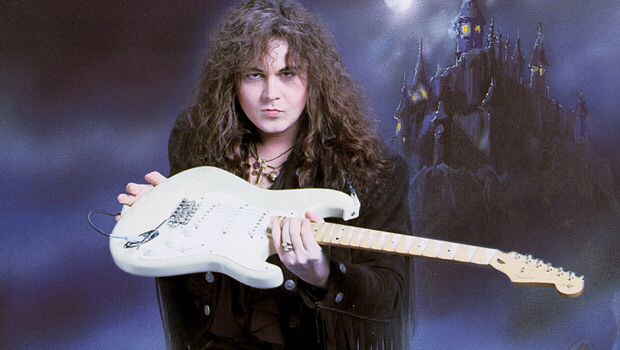
I looked up to greats like Petrucci and Malmsteen, who claimed they’d practice 6 to 15 hours, every. single. day. Despite being some pretty unreasonable and over-the-top claims, this resulted a younger, more naive version of myself developing an unhealthy dependency on needing to practice for huge periods of time to feel satisfied and happy with myself and my playing.
It was this obsession that – I only later realised – proved ultimately detrimental to my playing and performance, and only served to hinder my growth as a musician.
It only took a couple of months of practicing this way before my passion for playing vanished. I had no excitement when picking up my guitar in the morning; I had to force myself through each hard slog of a practice session, always dreading the next. Music as a whole began to lose its magic, and for me became a source of apathy, rather than joy or excitement.
Yet I was still in denial. My mind was firmly stuck in the ‘more=better’ mindset, and I couldn’t understand why I was growing so jaded, unhappy and disinterested with music as a whole. What it took was a fierce bout of emotional hardship and a long period of soul-searching, for me to open my eyes to the fact that:
Practicing is not all there is to life; practice by itself doesn’t equate to success.
Now, I live by this knowledge, and it has only helped me to grow as a musician – quicker, in fact, and things have never been better.
I don’t want for you to have to go through those burdens to develop a healthy mindset when it comes to practice, and so I’ve put together the following advice from my experience, purposed to help you get the most from your practice, without the bones.
Why practicing doesn’t = success.
As the age-old adage goes: ‘practice makes perfect.’ This argument is 100% merited; you always need some element of rehearsal and planning to do well in any field.
But look at any professional who’s ‘made it’ in the music industry, and you’ll see countless other factors that have compounded upon their practice, and have served to make them the musicians they are today. Such factors usually include:
– A huge network of industry peers and friends
-A supportive ‘mastermind group’ of close friends who are unfailingly faithful and dedicated, even through the toughest of times
-A big focus on relationship/communication skills
-An optimistic, growth-based mindset
-Networking habits; emphasis on expanding their circle of influence
-A positive self-image
-A healthy and fulfilled lifestyle away from music
-A Focus on strengths, and a love of their product, no matter what the outcome.
As musicians, we have a natural tendency for developing bad cases of tunnel vision when in the process of learning or creating music, and it’s this tunnel vision that restricts us from developing a healthy mindset around our lives and music; being able to see the bigger picture. Thus, we tend to lose track of the above factors in our quest to maximise our practice time. We try do more, instead of doing less but doing things smarter.
So, we can definitely see that success in music is – despite what you may think – not solely based on the number of hours you spend in the practice room. Rather, I’d argue that the above traits, in tandem with virtue of character and direction/ purpose in both practicing and playing are the (often overlooked) more important elements in making success in the music industry.
Plus, developing these traits will almost certainly increase your quality of life, which will play into your music, too. Implement these, and soon you’ll see that every area of your life will become elevated, along with your attitude to music.

But surely I still have to practice, right?
Of course!
Though practice does not equal success, it can certainly help you along the way as a means of increasing your momentum toward it. But as we’ve mentioned, more practice does not mean more results. Rather, the right practice is the true catalyst in elevating your playing and performance.
What do I mean by that? Let’s check out your new toolbox.
The concentration paradox – and how to hack it
An interesting point of note when it comes to practicing is the concept of ‘diminishing returns’. Though we tend to have a ‘the more, the merrier’ mindset with regards to practicing, in this instance there is certainly too much of a good thing.
You see, we only have so much capacity to concentrate when learning and studying music. Being both mental and physical in nature, it takes a toll on one’s energy reserves much more significantly than most people would be lead to believe. Once the brain loses its capacity to properly concentrate on the information being fed to it, your information retention and improvement rate take a plunge, fairly quickly to boot.
So what can we do instead?
Two words: take breaks.
Now I don’t mean scrolling through social media, or watching Netflix. A true break is exactly as its name implies: a break from any and every kind of stimulation. The less mind-intensive, the better; try these on for size:
-Walking in nature
-Meditating
-Eating a meal mindfully
-Just sitting and doing nothing for a while
Don’t worry if you find these boring (that’s the point!). You’ll soon be eager to jump back into practice because it will be much more exciting by comparison.
Longer-term breaks are critical too. Our minds need time away from the things we’re learning and practicing to fully absorb and consolidate them. If we’re always banging away at the same concepts, day after day, our mind actually loses its ability to absorb information – in other words – everything goes in one ear and out the other, making our practice almost completely pointless.
The Power of Sleep
One of the key processes in our ability to accurately absorb, develop and maintain information comes through both the quality and quantity of sleep we experience.
Whereas our memory and motor functions may be sketched onto our minds during the day, at night they are permanently branded in, and this is the make-or-break factor when it comes to learning almost anything musical.
At the risk of a gross oversimplification of sleep hygiene, you should aim for ~8 hours of undisturbed, quality sleep every night, maintaining a consistent schedule for sleep-wake times.
Practicing your most memory-intensive chunks of music just before bed, and consolidating said material just after waking up is a great habit to learn more effectively and efficiently.

And if taking breaks means taking an extended break from music for a couple of days or weeks, so be it. We seldom realise, but it’s often during these periods away from our instruments that we see the most important developments in both ourselves and our musicianship.
The subconscious mind is an amazing thing, and has the ability to work on what you’ve learnt and worked on without needing your guitar in-hand. More often than not, you’ll return to the practice room refreshed, excited, and who knows? You may develop a whole new lease on music, if not a whole new lease on life.
The Power of Pomodoro
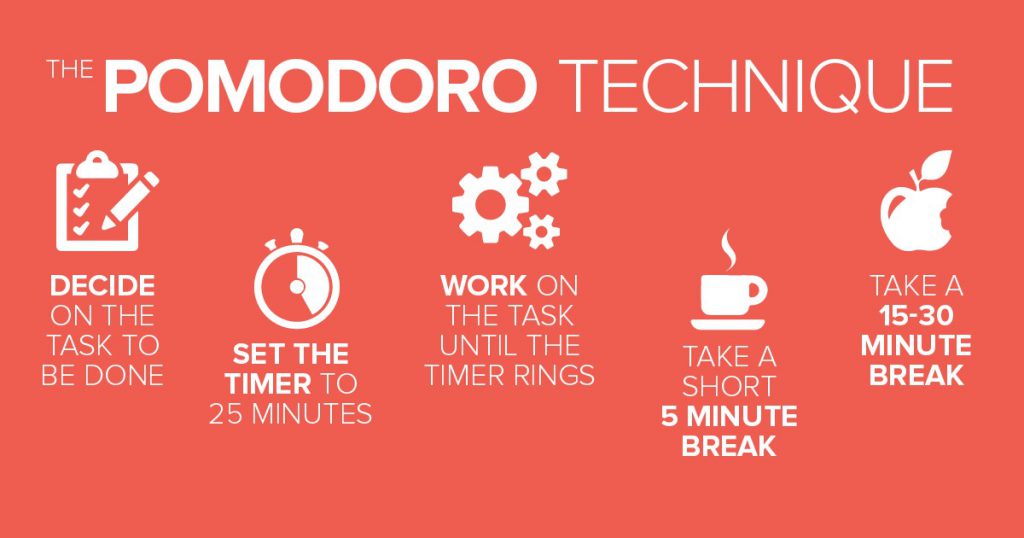
Another method that can maximise your gains in the practice room is the ‘Pomodoro Technique’, which works as follows:
1. Set a timer for 25-30 minutes, and eliminate any potential distractions around you (phone, email, noise, etc.)
2. Begin working on a single task (scale, lick, song section, etc.) for the entirety of the timer’s duration. During this, we want to maintain the utmost focus and attention towards this subject and this subject alone.
3. Once the timer has finished, take a 3-5 minute break. Go for something that is as minimally mentally intensive as possible,
4. Rinse and repeat the process, remembering to take longer breaks once you feel yourself becoming disengaged, or begin finding it difficult to concentrate.
To make the most of this technique, try to purpose each ‘block’ of practice toward a specific concept or area that you would like to work on, e.g scales, transcribing, learning a new song etc. by learning in this manner, you’re now fast-tracking your way to learning efficiently and effectively
Variety: It’s The Spice of Life.
And the final key to keep your practice sessions productive and effective is to keep variety at the top of your list of priorities. You shouldn’t only aim to practice what you’re good at, nor should you only practice your weak areas. Focus on consolidating your strengths whilst always striving for improvement in areas you struggle in. Try and split these two components 50/50 and watch your results grow exponentially.
Another aspect of variety should come through the music styles and genres you learn. Shredding prog day in, day out? Try some jazz fusion on for size. Experimenting with classical? How about expanding your horizons to bluegrass? Why relegate yourself to just one musical area when there are almost limitless other worlds waiting to be discovered?
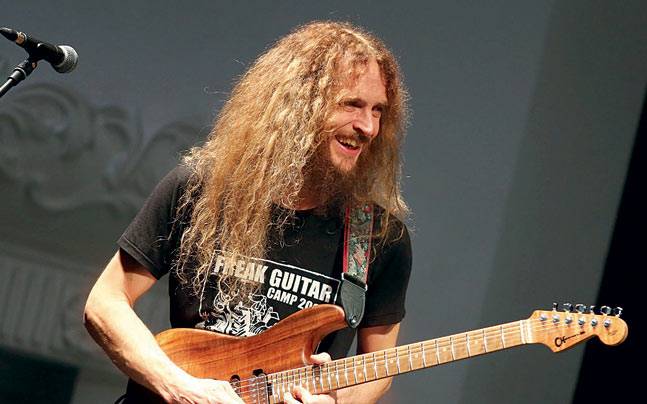
One guitarist that unfailingly inspires me to expand my horizons is Guthrie Govan, a true virtuoso and master of a huge number of styles. Give him a listen and I’m sure you’ll agree.
Your enjoyment of the music that you practice is massively important, too. Though you should try to incorporate unfamiliar music (that you may not necessarily like) into your musical diet every now and then, always strive to dedicate a portion of your practice to music you genuinely love. For musicians, staying engaged and connected is half the battle, and if you’re enjoying what you’re doing, your development and progress will increase tenfold.
Beyond The Practice Room
Two of the most poignant philosophies that have helped me on my musical journey go as follows:
‘The real practice happens on the stage’
and
‘One gig is worth 100 practice sessions’
I think that it’s fairly certain that the majority of us don’t just practice for the sake of practicing. Rather, we want our toil to serve a greater purpose, to take us somewhere on our musical journey.
Nobody wants to spend their life as a ‘bedroom warrior’, right?
And this is why it’s so important to not relegate yourself to the practice room; instead meet as many people, and as many shows as possible, because that’s where the real practice happens.
Interlocking with other musicians, engaging crowds, having showmanship and being a great entertainer, negotiating with contractors: all critical parts of navigating the complex and difficult world and business of music, yet how many of us really practice these concepts ourselves?
Always strive to increase your network size and your contacts; you never know who you may connect with. By and large, our circle of people can easily outweigh our actions when it comes to building our successes.
Back To The Roots
If you find yourself struggling in your musical journey, it can often be super useful to revisit your first encounters with music:
What made you pick up your instrument in the first place?
What feeling did it give you?
What were the first songs or artists you really resonated and connected with?
What were your initial goals when you got into music?
Arguably one of, if not the most important factor; it’s imperative to revisit this this ‘why’ aspect when it comes to practicing. What purpose does practicing serve for your big-picture plan? It’s surprising how much we forget to ask ourselves these all-important questions, and how easily our forward progress can be inhibited when we lose sight of what we’re actually working toward.
Once you figure these out, it can be super useful to write down your ‘why’ physically, and put this written document where you can see it daily, such as above your bedhead, or on your bathroom mirror. This way, you can ensure that each and every element of your practice provides real value to the ‘bigger picture’, and your ongoing goals as a musician.

People Skills: If you’re going to practice anything, practice this.
If there’s anything that I want you to take away today, it’s that the person makes the music, not the other way around. Nine times out of ten, the process of writing, playing, or recording music will be shared with another human being. Plus, music is a language; why learn a language if you’re only going to speak it to yourself?
It’s often overlooked that as humans, we invariably favour those who we enjoy to be around- those who are amicable and friendly – over musicians who may be true virtuosos, but are standoffish or acrimonious. A massive part of both writing and recording is the ability to maintain a positive and creative atmosphere in the studio, and the last thing any musician wants is to have to sacrifice this sentiment, even if they could achieve a more polished end product.
“Music is a communication. It’s a two-way street. You need people to play to in order to make that connection complete.”
– John Petrucci
No person on this earth has achieved incredible or noteworthy feats without building circles of those always ready and willing to offer their support and guidance when the going gets tough. In other words, it’s not just about what you do; it’s also about who you bring along for the journey.
In Summary
Practice is paradoxical. As beneficial as it often is, there are so many pitfalls inherent that can do more harm than good. Still, it’s a necessity, so that journey we must venture, despite our apprehensions. And since music is largely about this journey – not the destination – we should strive to make that journey as exciting and wonderful as we can.
That’s the true magic of music.
Thanks for reading; take care of yourselves, and let’s take a moment to remember why we began music in the first place:
Because we love it.
Want the Free Ultimate Prog Chord Compendium? Sign Up below!
Further Reading
http://healthysleep.med.harvard.edu/video/sleep07_stickgold_learning




 Simply Guitar